
Designing Floating Islands for Nutrient Cycling
BioHaven Floating Islands are a form of floating treatment wetland designed to cycle nutrients into and through both the macrophytic and heterotrophic arms of freshwater food webs. We take our design inspiration from naturally occurring, peat-based floating islands that typically occur around the 45th parallel of the Northern and Southern Hemispheres.
While BioHavens mimic naturally occurring peat-based floating islands, we face an ongoing conundrum… how to configure islands for optimal nutrient cycling. Our design conclusion, which is permeable and subject to ongoing revision, is that nature’s model is versatile. So we are too. In general, however, we attempt to maximize surface area, circulation, and riparian edge surface area. We have found that these guiding parameters result in maximized cycling of nitrogen and phosphorus. When the design is successful, a water body can be guided towards maximal nutrient cycling. The corresponding “productivity” is our goal, and our reward.
It is clear to us that Earth is neutral. Earth doesn’t feel a loyalty to humans or our condition. We are simply one of the current life forms occurring on this planet’s surface. We’ve also learned that Earth can be a willing partner. This partnership is valuable because it can result in maximized life of air-breathing biota. While it’s clear that there are other forms of life, we are biased in favor of the aerobic model.
Floating Island International has launched projects across the planet. We have noted that in some settings, the macrophyte-based food web dominates, like in North America. While in Sri Lanka or Singapore, for example, the heterotrophic base dominates. And we have learned that when both are brought together, nutrient cycling is maximized. And this is a key point: when nutrient cycling is maximized, sludge development is minimized. And sludge is what engenders biogenic methane, the form of methane that will supplant carbon dioxide as the primary agent of climate change within this decade, unless dealt with.
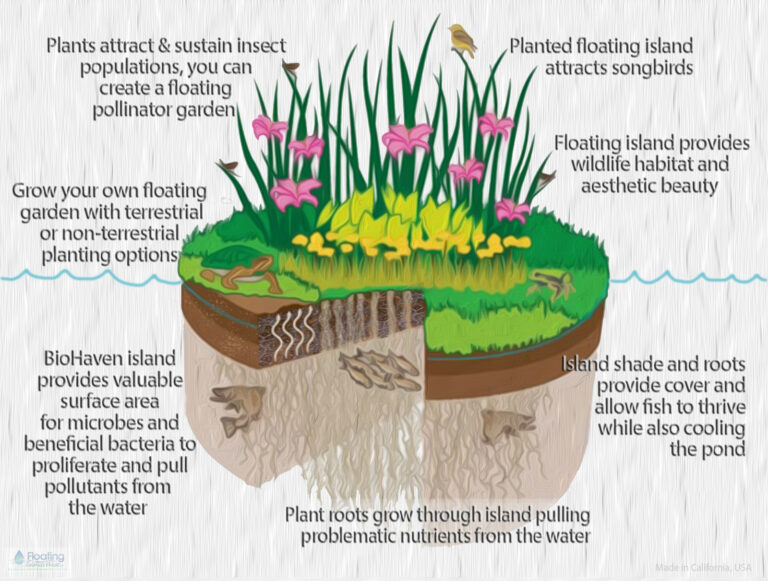
Grow fish instead of methane. This is an easy goal to buy into. This goal is at hand. Each BioHaven module is designed to maximize for riparian edge, the hardest and most expensive of habitat options to recreate. BioHaven modules are standardized into practical dimensions that make for reasonable handling and shipping. And since our goal is, approximately, one billion of these modules, the above factors are critical. So when you ask… how much island does my water body need to avoid slipping into a monoculture of algae, or a desert of open water where fish are just passing by on rare occasions?… know that seamless biofilm reactors, BioHaven island modules, are a form of linkage that can provide the habitat design synergy needed to fix your water body.
Every cubic foot of BioHaven provides at least 375 square feet of surface area. With circulation, this volume of biofilm reactive surface area will cycle at least .05 lbs of phosphorus out of your water per year. If you contribute to the stewardship of your water actively, this number expands. Bottom line, wise management always includes strategic harvest. Given wise stewardship, your water body will be both pristine and incredibly productive, beyond any standardized trophic level. In fact, we’ve had to develop a new term to describe this phenomenon…Transition Water.
How much island does your water body require to be healthy? The answer is…how much phosphorus is in your water body, and how much has to be cycled out to reduce the concentration of P to less than .02 ppm. Sure, nitrogen plays a role as well, but we’ve learned that focusing on P is inevitably what is required.
Life on this planet probably began in water. By stewarding water consciously, by nurturing it, we may be able to prevent the most drastic of climate change phenomena. While it’s clear that we are at the advent of a major extinction event today, it’s possible that BioHavens may buy humanity some time. And it is absolutely clear that biogenic methane is the primary agent to address in order to buy this time.
To date, FII has launched fewer than 100,000 floating island modules. But then, we are not a production system. We are an R&D entity. Our job is to license BioHavens to the optimal manufacturer.
If you are an effective human being and you are inclined to facilitate the survival of humanity, please consider collaboration. I am FII’s current CEO. I am also strongly biased in favor of Humanity. I think we deserve a chance to participate and influence life in this universe. So without further preamble, please know that collaboration is welcomed. I look forward to working towards the mitigation of the current extinction event in order to buy time for humanity to evolve.
– Bruce Kania, CEO Floating Island International