
The BioHaven Floating Breakwater (BFB) is a floating wave attenuator.
It uses enhanced BioHaven technology to create sustainable green infrastructure that mitigates coastline erosion and promotes restoration. We refer to it as Living Shoreline. In 2014, the Floating Breakwater received the endorsement of The Water Institute of the Gulf as an innovative technology for shoreline protection and bank stabilization. Our associates pioneered the BFB for use on the US Gulf Coast, where several large
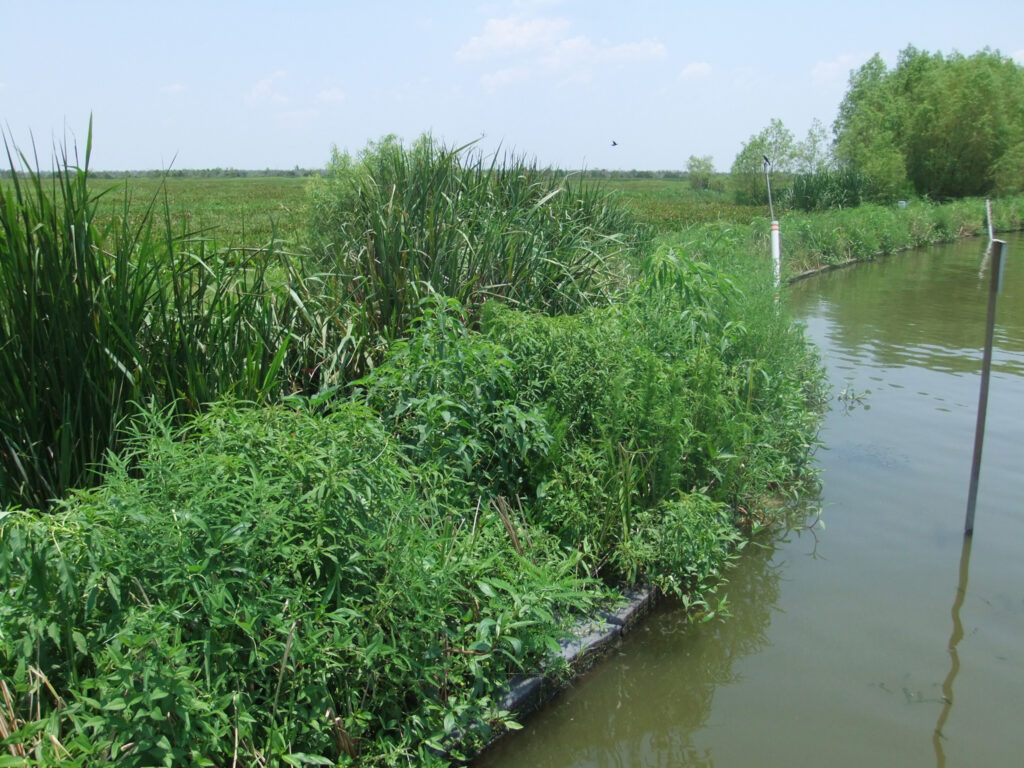
Implementations are currently in use for:
- Shoreline Protection through wave mitigation
- Marsh creation through sedimentation in the lee of the BFB
- Habitat restoration and other ecological benefits
Future applications may include Floating Solar installations, either as perimeter protection or as the FPV platform itself.
Floating wetlands – both natural wetlands and BioHaven Floating Islands – act as wave mitigators because they function in the upper part of the water where wave energy is concentrated. They effectively reduce wave height and energy in the lee of the structure by dissipating the kinetic energy of incoming waves. Energy loss results from waves breaking on the face of the structure and turbulent flow caused by the interaction of wave and structure. Unlike solid structures, such as sea-walls or even rip-rap, BioHavens don’t reflect the waves and push the energy downstream; they dissipate wave energy. Independent studies have documented their ability to reduce chop-waves, the most difficult to attenuate.
Improve Shorelines & Coastal Regions with Floating Islands
A floating breakwater will look natural and beautiful compared with one that’s made of concrete and filled with polystyrene. Under ASTM standards, polystyrene is regarded as not biodegradable. It accumulates as a form of litter in the outside environment, particularly along shores and waterways, and most notably in the Pacific Ocean. It is not commonly or easily recycled. It may be inexpensive to purchase, but its clean-up cost to the environment is huge as the non-biodegradable debris turns up along beaches and in the bodies of wildlife.
Concrete water tanks are lined with protective armor that is safe to humans. Pick-up truck beds are lined with coatings to protect them from almost constant UV light exposure. BioHaven Floating Islands are protected with this same “armor”. A spray coating of polyurea protects the 100% recycled matrix from UV damage and environmental damage (for example, the constant pounding of waves, incursions by nutria and muskrats) and makes for a long-lasting and safe environmental alternative.
Features Include:
- Mimics natural sedimentation processes of coastal ecosystems and creates new marsh
- Protects shorelines
affected by erosion from wave action and boating activity - Attenuates waves such as chop waves / wind chop
- Manufactured to hold anchor through hurricane-force winds and storm surges
- Floating structure eliminates concerns about sinking and rises and falls with the tide
- Wave attenuation properties protect assets such as floating solar panels
- Mitigates wake energy from recreational users such as water-skiers and wake boarders
Wave mitigation for varied purposes
We address obstacles to floating solar
Floating Island products are backed by 12 years of independent research.
- Buoyancy. Today we have single-module, seamless, floating islands of about 95 square feet that can support 2,500 pounds of negative buoyancy. These can be attached together to form custom-size platforms.
- Stability. A saturated BioHaven will weigh twenty times as much as a similar footprint of pontoon and will accumulate mass as it ages. This allows a well-anchored BioHaven platform to maintain a stationary position in the face of hurricane-force winds. Massive waves hit them, and their energy is sparged and dispersed within the water-damping matrix. Wind chop is attenuated.
- Durability. 60+ years. Advances in construction methods include a tough coating of “armor” that protects the outer surfaces from UV and environmental damage. This is the same material that protects the insides of municipal water inventory tanks.
- Strength. These islands, framed together as massive archipelagos, can support seven or eight times their square footage of solar panels. The largest existing BioHaven in North America is a 40,000 square foot island that supports 900 tons of gravel.
- Resilience. BioHaven Floating Islands have withstood hurricane-force winds in the Gulf of Mexico, 48-inch snow dumps in the ocean off the coast of Alaska, a tornado in Montana, a typhoon in Singapore, and a two-day windstorm in Oregon.
All of these qualities put BioHaven Floating Island products at the top of the list of solutions to problems requiring wave mitigation.
Be a Part of the
Change, Starting
with our Water
Whether you have questions about our technology, need support, or want to share your feedback, our dedicated team is here to assist you every step of the way.
Email
info@floatingislandinternational.com
Phone
+1 406.373.5200
Location
Helena, MT