
What are Harmful Algae Blooms (HABs)?
HABs are caused when too many nutrients present in the water overtax the ability of the natural system to remove them. Many bodies of water receive inflow from agriculture, stormwater management, septic systems or landscaping, which carries an unnaturally high nutrient load making them susceptible to HABs. HABs affect municipal waterways and recreational ponds as well as large lakes and have become a global environmental problem.
HABs are harmful to aquatic life, animals, and even humans. An algae bloom is usually offensive, creating unpleasant smells and turning water green and cloudy. HABs can also result in fines and citations from environmental regulatory authorities.
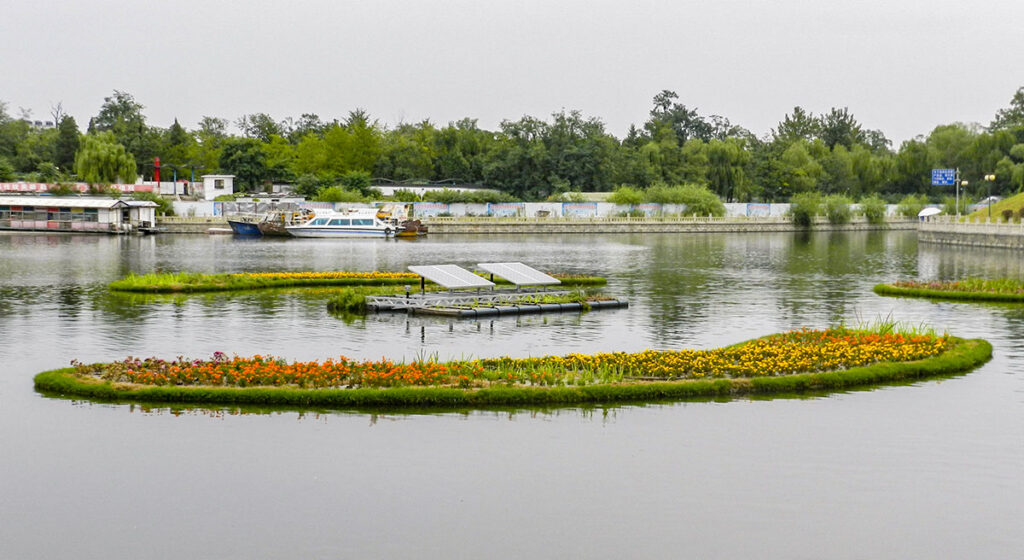
BioHaven Solutions for Harmful Algae Blooms:
BioHaven Floating Islands have been used in ponds and small lakes to treat algae for over a decade and their success has been well documented. Please refer to the BioHaven science section for a refresher on how BioHavens work.
On large lakes and even drinking water reservoirs, the limiting factor is funding. Harmful Algae Blooms are on the increase, in number and severity, and technology is needed on such a large scale it is virtually unaffordable.
Our BioHaven Floating Islands, BioHaven Streambed, and BioHaven Floating Solar all can help combat HABs.
Treat Harmful Algae Blooms Holistically
BioHaven Floating Islands represent a holistic way to remove the problem-causing nutrients from a waterway and convert them into a beautiful and wildlife-enhancing floating island habitat. The process starts with the massive surface area provided by FII’s BioHaven matrix which “houses” more microbes, and more microbes equal cleaner and healthier water.
The microbes that form biofilm on BioHaven Floating Islands feed from the same nutrients that algae feed from. The more BioHavens doing duty as housing units for biofilm, the more microbes are present in the pond. The more food they eat, the more they will starve out algae.
In addition to supplying surface area for biofilm, the roots of the island plants extending downward keep usable oxygen in the water, carrying it to a depth of up to four feet, the zone where the majority of a pond’s life abounds.
As biofilm exudes a sticky polymeric substance (EPS), it becomes surrounded by periphyton that provides plant-like food for aquatic invertebrates and small fish. As each trophic level is consumed by the next, phosphorus is used up and – when eventually harvested – leaves the pond for good. So, biofilm is at the heart of the process by supporting many pathways for removal of nutrients.
A floating island also decreases the water temperature in its shade by almost three degrees Fahrenheit, which is significant for all life that is susceptible to extreme heat.
These biological processes will not eliminate algae altogether but will prevent them developing into a monoculture and choking the water body, depriving it of oxygen. Over time, the pond will develop a new balance and the problem of HABs, odor, and toxic water will be a thing of the past.
BioHaven biological processes are considerably enhanced by aeration and circulation. NanoHavens deliver a gentle stream of nanobubbles, allowing almost-pure oxygen to penetrate water right down to the sediments without disturbing the stratification (important for fish during the winter). StreamBeds are an inexpensive way of circulating and mixing the top layers of water and using “daylight” to add oxygen to water.

Benefits of the BioHaven Solution:
- Odor reduction
- Reduction and prevention of algae
- Prevention of greenhouse gas emissions, particularly methane
- Sludge reduction
- Restoration of aquatic food web
- Pond clarity and health
- Biodiversity
- Enjoyment of the amenity
- Long-term health and sustainability
Reduce Algae, Impact Climate Change
Stagnant water is responsible for producing some the most potent greenhouse gases, namely methane and nitrous oxide, which are far more destructive to the atmosphere than carbon dioxide. Every BioHaven launched into such water helps prevent the formation of these gases. Until now, solutions on the scale needed to fix the widespread problems have been unaffordable. With BioHavens performing as floating solar platforms, the ability to produce clean energy to offset the costs of treatment at last makes treating Harmful Algae Blooms feasible.
Frequently Asked Questions
What is Golden Algae
Golden Algae is a specific type of algae bloom that affects the Southern US and is most prevalent in the fall. It is very difficult to eradicate. BioHaven Floating Islands are one of the few treatment technologies that have proven successful.
Why is my water green?
If the water in your pond or lake is green, it’s probably because of algae. A life form called phytoplankton, which is a type of algae, grows in certain conditions in water. Green water algae float freely and multiply by the billions in a short period of time. When algae grows quickly, it’s known as an algae bloom.
Algae blooms often smell bad and release toxins.
When algae blooms persist, you could end up with a harmful algae bloom, or HAB for short. When the algae die, their decomposition consumes the oxygen needed by fish and other aquatic life. If enough oxygen is removed, there is not enough oxygen to sustain life, creating a “dead zone.”
Homeowners Association Plagued by Green Water?
What conditions make pond and lake water green? Algae growth is spurred by pollution including fertilizer runoff from farms and even lawn care. This adds nitrogen and phosphorus to waterways, two nutrients that are essential to algae growth.
Algae blooms often smell bad and release toxins.
When algae blooms persist, you could end up with a harmful algae bloom, or HAB for short. When the algae die, their decomposition consumes the oxygen needed by fish and other aquatic life. If enough oxygen is removed, there is not enough oxygen to sustain life, creating a “dead zone.”
Can green water kill my dog?
Green water might be a sign of cyanobacteria, a toxic species of algae that can kill your dog if they drink it or even have skin contact with it. Cyanobacterial poisoning is most common in freshwater and estuaries and your dog might love the way it smells (it smells bad). You should not let your dog roll in piles of algae or swim when the water is covered with a green slime that looks like a paint spill or water that is green.
Is green water dangerous?
According to the National Oceanic and Atmospheric Administration, “the most common cyanobacterial HAB toxins in the U.S. are microcystins, a group of liver toxins that can cause gastrointestinal illness in humans, and mortality in pets, livestock, and wildlife.” People exposed to microcystin may experience symptoms like nausea, diarrhea, skin rash, respiratory problems and headaches.
Also, the green, slimy algae can use up all of the oxygen in the water creating what is known as a dead zone. There are many of these around the world. Perhaps the most well known is in the Gulf of Mexico. Nothing can live in it.
Many bird and mammal species can be affected by green water. Toxins from algae have been implicated in the deaths of brown pelicans and Brandt’s cormorants, common terns, shags, great cormorants, northern fulmars, herring gulls, common murres, Pacific loons, sooty shearwaters, as well as free-ranging ducks, geese, eared grebes, gulls, and songbirds.
When source waters are contaminated with harmful algae and bacteria, drinking water supplies are affected.
Economic damages related to cyanobacteria blooms include the loss of recreational revenue, decreased property values, and increased drinking-water treatment costs.
What is Golden Algae?
A resilient and fast-growing species of algae, golden algae is toxic to fish and other gill-breathing organisms. A huge bloom in Texas resulted in the death of over one hundred and fifty thousand fish. When golden algae blooms, that is, it grows rapidly, the water begins to turn yellowish, yellowish-copper or a brownish, tea color.
“Golden alga was first discovered in the United States in Texas in 1985. Since then, it has caused fish kills in five major river systems and over 25 lakes or reservoirs in Texas. Texas officials have estimated the direct economic loss of over 18 million fish due to golden alga as $7 million. This toxin producing algae has now been documented from 12 states ranging from North Carolina to Georgia to Wyoming to Arizona.” (source: https://www.azgfd.com/fishing/golden-alga/)
Golden Algae is very difficult to treat, but BioHaven Floating Islands have been used successfully.
Golden algae can generate toxins that can kill a lake’s ecosystem in a matter of days.
Also, the green, slimy algae can use up all of the oxygen in the water creating what is known as a dead zone. There are many of these around the world. Perhaps the most well known is in the Gulf of Mexico. Nothing can live in it.
Many bird and mammal species can be affected by green water. Toxins from algae have been implicated in the deaths of brown pelicans and Brandt’s cormorants, common terns, shags, great cormorants, northern fulmars, herring gulls, common murres, Pacific loons, sooty shearwaters, as well as free-ranging ducks, geese, eared grebes, gulls, and songbirds.
When source waters are contaminated with harmful algae and bacteria, drinking water supplies are affected.
Economic damages related to cyanobacteria blooms include the loss of recreational revenue, decreased property values, and increased drinking-water treatment costs.
What are Harmful Algae Blooms, (HABs)?
HABs are Harmful Algae Blooms, used to describe the conditions that occur when algae is allowed to overtake a body of water. Often this will make water green. It is called a “bloom” because the growth is very fast- it blooms overnight or even in a matter of hours.
In some communities, algae blooms are called “red tides” because of their color.
The best source on the internet to really get deep into understanding toxic algae blooms is probably this USGS page:
In NY State in 2011 there were seven reports of HABs. In 2018 there were 394 reports. This could be associated with an improved reporting method, but regardless of this, we know that the incidence of harmful algae blooms across the world is increasing and will continue to increase.
What are the causes of harmful algae blooms?
In every case of HABs, the build up of micro-nutrients, particularly nitrogen and phosphorus, either causes the problem or makes it worse. When grass clippings, leaves, fertilizer and other nutrient loaded organic debris gets into a water body, they decompose and release nutrients as they break down. These nutrients stack up and don’t move through the food web. Algae thrive with this imbalance of nutrients, to the detriment of all other life in the water.
According to the U.S. Environmental Protection Agency’s 2016 study of national water quality, nutrient pollution in the United States was a problem in more than one-third of lakes and about half of all rivers and streams. And we know that this problem has become more prevalent over the last five years.
Drought, diverting water for irrigation or drinking, and human interference with natural waterways contributes to water moving slowly or even stagnating in a pond. Slow-moving water can become stratified, where a layer of warm water floats on top of cooler water. Algae thrive in still water.
What does a harmful algae bloom look like?
A harmful algal or cyanobacterial bloom can look like scum, foam, spilled paint, or carpets on the surface of water and can be different colors. Blooms occur in freshwater, such as ponds, stormwater catchment basins, lakes, and rivers, and salt water, such as oceans or bays.
Although it is called “blue-green algae,” these blooms can be blue, green, red, brown, or orange.
Will the HAB go away on its own? It might, but if you have a lot of nonpoint source pollution and excess nutrients feeding it, it will absolutely stay around. How long an algae bloom lasts depends on the conditions that influence it, including the water temperature, amount of sunlight, availability of nutrients, the acidity and the salinity. The persistence of HABs are also influenced by the speed and direction of wind and water currents.
What are the solutions to HABS?
Prevention is the best method. Avoid the green water in the first place by limiting runoff from fertilized lawns or agriculture into the basin. Build a protective vegetative buffer around the edge of the pond to help filter runoff before it reaches the pond.
There is a chemical-free way to clean water: Concentrated surface area and circulation launches the freshwater food web.
When a waterway is in transition back from green to clean, you will see that the water clarity, coloration of fish, smell of fresh water, and biodiversity multiplies when you take nutrient rich water and help it cycle back into a healthy food web. It is possible to turn the problem into the solution. It might even be able to be better than before because all the nutrients feed larger species of fish and desirable plants when a waterway is managed.
Nanobubblers are a solution to harmful algae blooms. Combined with a floating island’s matrix and surface area and a localized power source, BioHaven’s NanoHaven is a versatile and powerful natural solution to green water.
HABs and drinking water: When source waters are contaminated with harmful algae and bacteria, drinking water supplies are affected. Many water treatment facilities are not designed to remove the most toxic organisms and inadequate treatment can compromise water quality and threaten public health. According to the EPA, in 2013, the Ohio EPA had to stop drinking water supplies from Lake Erie, and that location has been a focus for research into HABs and drinking water supplies.
If the cyanotoxins get into a regional or municipal water delivery system, the water becomes dangerous and the entire system must be flushed, as happened in Toledo in 2014. Residents were unable to drink, cook, or bathe with water from their faucets.
The 1972 US Clean Water Act was passed largely in reaction to chemical and industrial pollution causing lakes to burst into flame. It contains no guidelines for nutrient pollution.
HABs and Climate Change
Does green water contribute greenhouse gasses to the atmosphere? Yes. Carbon dioxide, nitrous oxide, and most harmfully, methane, are all greenhouse gasses (GHG) that are emitted from green (impaired, eutrophic, and hyper-eutrophic) water.
A recent study in Hong Kong assessed the impact of water pollution on greenhouse gas emissions. It indicated that rivers in the area are persistent and significant sources of atmospheric greenhouse gases. The global warming potential of methane is many times larger than that of carbon dioxide. Rivers are a significant source of greenhouse gas emissions. It is estimated that aquatic systems contribute more than 50% to atmospheric methane (CH4), and global river nitrous oxide (N2O) emissions have gradually exceeded 10% of human emissions.
We must combat algae to reduce climate emissions.
Be a Part of the
Change, Starting
with our Water
Whether you have questions about our technology, need support, or want to share your feedback, our dedicated team is here to assist you every step of the way.
Email
info@floatingislandinternational.com
Phone
+1 406.373.5200
Location
Shepherd, MT