
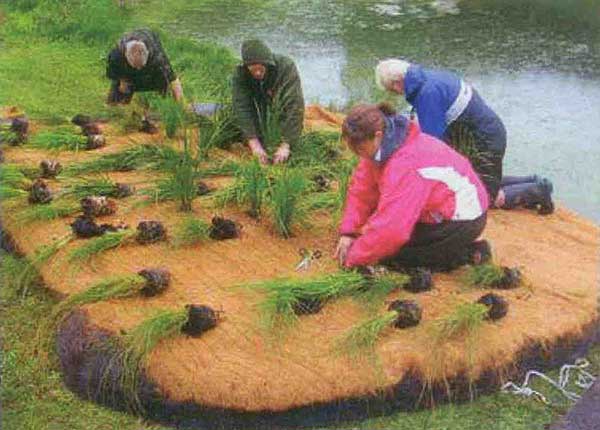
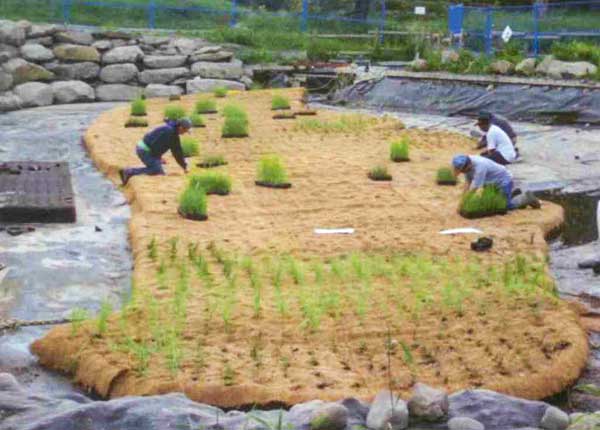
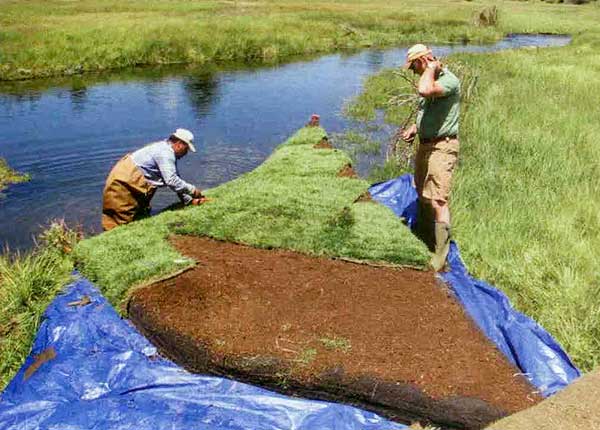
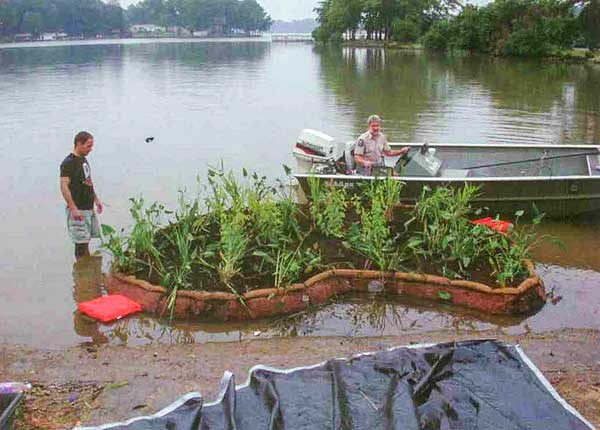

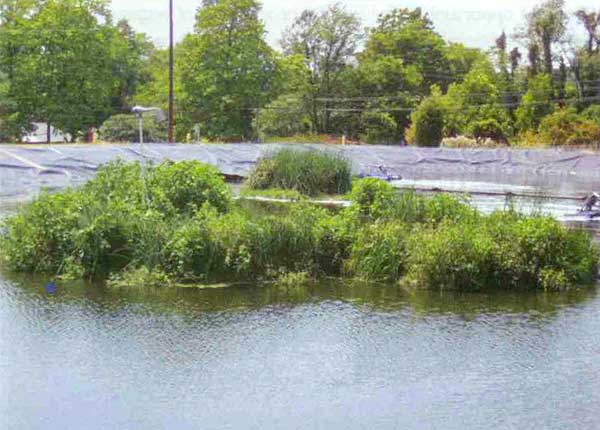
With respect to water treatment, sustained functioning of the BioHaven biofilm is always ‘switched on’ and is independent of water depth in the pond. Thus, the BioHaven-equipped pond is not constrained by biological lag time – i.e. until the biofilm is regenerated after a period of low water levels and exposed plant and inert surfaces typical of a conventional pond or small reedbed. System start-up and establishment is also much shorter; with BioHaven islands becoming fully vegetated and established within as little as 60 days.
Although the BioHaven island can be utilized solely as a biofilm support system, the islands can also be planted with aquatic or terrestrial vegetation in accordance with the client’s requirements. Given that the treatment function is now independent of vegetation on the shorelines, problems of unsightly, exposed shorelines are now completely resolved and other means of constructing the pond sides and edges can be considered. Retention ponds, or sectors thereof, can now be made deeper; thus, enhancing the hydrodynamic stability and reducing the risk of sediment washout. Pond cleaning and maintenance aspects are rendered significantly easier.
Over 3100 launches of BioHaven islands have been made worldwide since the release of the product in 2005.The water treatment capabilities have been subjected to peer-reviewed scientific scrutiny by two organizations, the New Zealand Institute of Water and Atmospheric Research (NIWA, Headley and Tanner; 2006 ; Tanner and Headley, 2008) and the Montana Board of Research and Commercialization Technology (Stewart, 2007). The published results of these investigations have shown that significantly higher levels of nutrient assimilation and toxicant (e.g. trace metals) sequestration are possible using BioHavens, as opposed to conventional wetland processes. Efficacy has also been demonstrated in a Yale University study on the mitigation of estrogen impacts on fish. While local performance data is still to be assembled, reports from other countries indicate removal rates in ranges of grams per square meter of island per day for certain elements. These levels are simply not achievable in small ponds or reedbed systems. From the results accumulated to date, it has been possible to develop models to indicate the area of Biohaven islands required for a particular application.
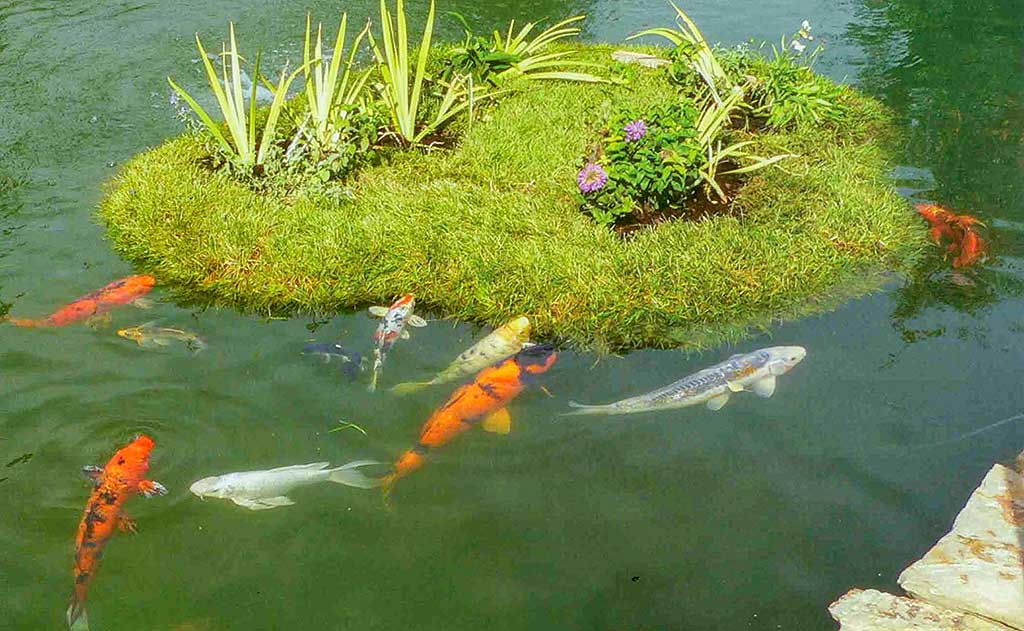 Small fishpond Island adds beauty to the waterway
References
Headley TR and Tanner CC (2006) Application of Floating Wetlands for Enhanced Stormwater Treatment A Review. NIWA Client Report prepared for the Auckland Regional Council. Report HAM2006- I24.
Stewart, F (2007) Biomimetic Floating Islands that Maximize Plant and Microbial Synergistic Relationships to Revitalize Degraded Fisheries, Wildlife Habitats and Human Water Resources. Final Report to the Montana Board of Research and Commercialization Technology
Tanner CC and Headley TR (2008) Floating treatment wetlands – an innovative solution to enhance removal of fine particulates, copper and zinc. Journal of the New Zealand Water Works Association July 2008:26-30.
Van Duzer C (2004) Floating lslands: A Global Bibliography. Cantor Press, Los Altos Hills, California. 400 pages plus illustrations.
Floating Island International is represented in South Africa by DH Environmental Consulting (www.dhec.co.za) which has already commenced with presentations detailing the opportunities possible with this technology. The modules will initially be imported but local manufacture under license is in the pipeline.
DH Environmental Consulting has 20 years of wetland assessment experience in South Africa and has obtained the sole distributorship for BioHavens. Dr Bill Harding (PhD) is a professional limnologist and aquatic ecologist (PrSciNat), and a certified lake manager, NALMS, USA. Email bill@dhec.co.za